During my foodspotting in Johor Bahru, I have tried many laksa stalls from the famous to the obscure. All the laksa stalls have their own stories. This is just one of the many stories - the story behind four of the most popular laksa stalls in Johor Bahru today.
My curiosity was piqued when I noticed that the laksa of Lee Kee, Tan Kee, Sam Kong and the laksa stall at Siak Hong are very similar.
They all use a soup base made by boiling anchovies and soy beans just like those at old school wanton mee stalls and fish ball noodle stalls. To the umami flavoured soup base, they add curry spices and santan (coconut milk).
While the curry broth is not very lemak, it has body and is savoury, flavourful and fragrant. Personally, I like this curry as it's body come from anchovies and soy beans rather than rely heavily on santan.
They all have this thin and crispy fried tofu skin served with the laksa.
The laksa comes with these handmade fried Ikan Parang fish balls.
The fish balls have good mouth feel and release a nice, distinct fish flavour and aroma with every bite. The stall holders make these fish balls from fresh Ikan Parang fish everyday.
The laksa comes with fried fresh tofu. A layer of rough fried brown skin with the white inside still soft and smells of soy beans.
The laksa comes with fresh cockles (see hum) which the hawkers shell daily.
I stumbled upon their story when I visited Sam Kong restaurant run by Mr. Yong in Kampung Ungku Mohsin.
Mr. Yong was showing me the curry spices that are used to make the laksa.
Johor Laksa Pioneers. A - Mr. Yong's grandfather. B - Mr. Yong's father. (Photo credit: Thanks to Joan, the great-great-granddaughter of old Mr. Yong.)
According to Mr. Yong, the origins of this style of Johor laksa dates back to pre-War Johor Bahru. A man from Guangxi taught Mr. Yong's grandfather how to use the spices available at Johor Bahru's "Little India" along Jalan Trus to make laksa before he returned to China.
Mr. Yong's grandfather used to run the laksa stall at the Foon Yew school which used to be in a bungalow belonging to Tan Hiok Nee, the Kapitan Cina at the time. The school tuck shop was under the bungalow which was on stilts.
The Japanese came in 1942 and left only 3 years later. After the war, at the request of his neighbour Mdm Lee, Mr. Yong's grandfather taught her the laksa recipe on the condition that she does not sell her laksa on the same street at Jalan Trus.
So, hardy Mdm Lee balanced the heavy pots of laksa across her shoulders and sold laksa by walking the streets of Johor Bahru.
Today, Mr. Yong who runs Sam Kong restaurant at #8-H, Jalan Ungku Mohsin still uses the same laksa recipe handed down by his grandfather.
Mdm Lee in turn spun off three stalls.
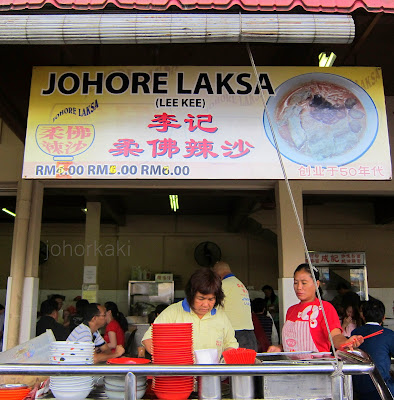
Today, Mdm Lee's son and daughter-in-law carry on the Lee Kee brand at Kee Kim Huat kopitiam at #80, Jalan Badik in Taman Sri Tebrau.
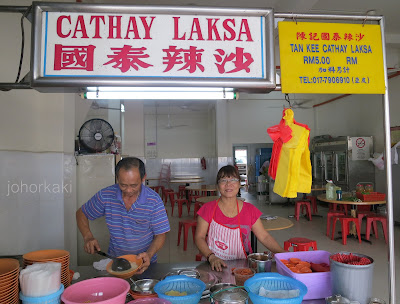
One of Mdm Lee's daughters and one of her workers are now the cheerful husband and wife team running Tan Kee in Shang Ji kopitiam at #149, Jalan Lumba Kuda. Tan Kee is famously known as Cathay Laksa because they used to run the stall near the now demolished Cathay cinema.
Mdm Lee's niece runs the popular laksa stall at what locals call "Siak Hong", the dozen of back lane stalls behind the Standard Charter Bank off Jalan Tebrau (opposite Plaza Pelangi). She also uses the brand name "Cathay Laksa".
During my foodspotting in Johor Bahru, I have tried many laksa stalls from the famous to the obscure. All the laksa stalls have their own stories. This is just one of the many stories - the story behind four of the most popular laksa stalls in Johor Bahru today.
My curiosity was piqued when I noticed that the laksa of Lee Kee, Tan Kee, Sam Kong and the laksa stall at Siak Hong are very similar.
They all use a soup base made by boiling anchovies and soy beans just like those at old school wanton mee stalls and fish ball noodle stalls. To the umami flavoured soup base, they add curry spices and santan (coconut milk).
While the curry broth is not very lemak, it has body and is savoury, flavourful and fragrant. Personally, I like this curry as it's body come from anchovies and soy beans rather than rely heavily on santan.
They all have this thin and crispy fried tofu skin served with the laksa.
The laksa comes with these handmade fried Ikan Parang fish balls.
The fish balls have good mouth feel and release a nice, distinct fish flavour and aroma with every bite. The stall holders make these fish balls from fresh Ikan Parang fish everyday.
The laksa comes with fried fresh tofu. A layer of rough fried brown skin with the white inside still soft and smells of soy beans.
The laksa comes with fresh cockles (see hum) which the hawkers shell daily.
I stumbled upon their story when I visited Sam Kong restaurant run by Mr. Yong in Kampung Ungku Mohsin.
Mr. Yong was showing me the curry spices that are used to make the laksa.
Johor Laksa Pioneers. A - Mr. Yong's grandfather. B - Mr. Yong's father. (Photo credit: Thanks to Joan, the great-great-granddaughter of old Mr. Yong.)
According to Mr. Yong, the origins of this style of Johor laksa dates back to pre-War Johor Bahru. A man from Guangxi taught Mr. Yong's grandfather how to use the spices available at Johor Bahru's "Little India" along Jalan Trus to make laksa before he returned to China.
Mr. Yong's grandfather used to run the laksa stall at the Foon Yew school which used to be in a bungalow belonging to Tan Hiok Nee, the Kapitan Cina at the time. The school tuck shop was under the bungalow which was on stilts.
The Japanese came in 1942 and left only 3 years later. After the war, at the request of his neighbour Mdm Lee, Mr. Yong's grandfather taught her the laksa recipe on the condition that she does not sell her laksa on the same street at Jalan Trus.
So, hardy Mdm Lee balanced the heavy pots of laksa across her shoulders and sold laksa by walking the streets of Johor Bahru.
Today, Mr. Yong who runs Sam Kong restaurant at #8-H, Jalan Ungku Mohsin still uses the same laksa recipe handed down by his grandfather.
Mdm Lee in turn spun off three stalls.
Today, Mdm Lee's son and daughter-in-law carry on the Lee Kee brand at Kee Kim Huat kopitiam at #80, Jalan Badik in Taman Sri Tebrau.
One of Mdm Lee's daughters and one of her workers are now the cheerful husband and wife team running Tan Kee in Shang Ji kopitiam at #149, Jalan Lumba Kuda. Tan Kee is famously known as Cathay Laksa because they used to run the stall near the now demolished Cathay cinema.
Mdm Lee's niece runs the popular laksa stall at what locals call "Siak Hong", the dozen of back lane stalls behind the Standard Charter Bank off Jalan Tebrau (opposite Plaza Pelangi). She also uses the brand name "Cathay Laksa".
When JoanCleo invited me to try out the food at her dad's Sam Kong 三江 restaurant, I didn't expect that I was there to learn about the history of one of the most famous and oldest laksa in Johor.
It turned out that JoanCleo's dad, Mr. Yong is the third generation owner of one of the oldest laksa stalls in Johor.
Mr. Yong, passionate about laksa, explains the spices that go into making laksa broth.
Mr. Yong's grandfather started selling laksa before the Japanese Occupation in the 1930s along Jalan Trus. Mr. Yong's grandfather learnt the trade from a gentleman from Guangxi, China. Before this man went back to China he showed Mr. Yong's grandfather how to make laksa using spices from the Indian shops at Jalan Trus in downtown Johor Bahru. Mr. Yong's grandfather then started to sell laksa along Jalan Trus near the old Chinese temple 柔佛古廟.
The World War came and after the Japanese left in 1945, Mr. Yong's grandfather in turn taught one of his neighbours, Mdm Lee, the trade. Mdm Lee started to sell laksa around the old town area by carrying the pots slung across her shoulders on a bamboo pole. Lee Kee laksa is still in business today at Kee Kim Huat kopitiam in Taman Sri Tebrau. Mdm Lee also passed on the art to one of her relatives who then started Tan Kee Laksa near the old Cathay cinema, hence the name Cathay laksa. Today, Cathay Laksa is still in business at Jalan Lumba Kuda. All three laksa stalls are still regarded as among the best in Johor.
Till this day, Mr. Yong makes the laksa broth every business day using the same recipe handed down by his grandfather.
Mr. Yong first fries the garlic, shallots, lemon grass and other ingredients.
Add the spices, belacan and fish bones, and continue frying at high heat till the choking, pungent aroma fills the air.
Add in water to make the broth. Santan will be added when the broth is nearly ready. The whole broth is then strained, leaving just the smooth laksa broth.
This large bowl of laksa costs RM6.
The laksa broth is the soul of this dish. The laksa broth is smooth, with just the right body - not overly lemak, and the complex blend of fragrances and aromas are pleasant - not pungent or overpowering. The broth has an umami flavour that holds all the fragrances and aromas together. This is one of the best laksa broths that I have tasted. The laksa broth is highly drinkable without the unpleasantness of feeling bloated.
I spent some 10 to 15 minutes photographing the laksa, yet the bee hoon did not turn limp and soggy. The bee hoon still had some spring because Sam Kong takes the trouble to air dry their partially cooked bee hoon before blanching them with laksa broth just before serving. It is small details like this that set the better shops apart from the average.
The delicious tofu with fresh fish filling is made right there at the shop. Everything is fresh.
Just looking at the crispy bean curd skin makes me want to take a bite at it.
I was amazed by Sam Kong's handmade fish balls. Sam Kong makes their fish balls using fresh ikan parang everyday. I can't remember coming across a fish ball with so much fresh fish flavour and such tender yet chewy mouth feel. Next time at the shop, I shall definitely ask the boss to add extra fish balls 加料 to my laksa :))
I just can't get enough of Sam Kong's fish balls, so I bought a kilo to enjoy it at home.
Sam Kong sells their marvellous fish balls (frozen) at RM38 a kilo. I have tested them at home and found that they taste good.
Sam Kong's sambal chili was great too - fragrant and mildly spicy. But, Sam Kong's laksa broth is so good, I didn't need this sambal chili to boost it's flavour. So, I just ate the sambal chili on its own - so good!
Click on the photos below to read about Cathay Laksa and Lee Kee Laksa.
Sam Kong restaurant is along Jalan Ungku Mohsin and just below the Johor Bahru Kwangxi Association office.
Restaurant name: Sam Kong Restaurant 三江 Address: 8-H, Jalan Ungku Mohsin, Kampung Ungku Mohsin, Johor Bahru Map: http://goo.gl/maps/N8BmU GPS: 1.514005,103.740173 Hours: 11:00am to 11:00pm (Monday closed) Non Halal
Date visited: 14 May 2013
When JoanCleo invited me to try out the food at her dad's Sam Kong 三江 restaurant, I didn't expect that I was there to learn about the history of one of the most famous and oldest laksa in Johor.
It turned out that JoanCleo's dad, Mr. Yong is the third generation owner of one of the oldest laksa stalls in Johor.
Mr. Yong, passionate about laksa, explains the spices that go into making laksa broth.
Mr. Yong's grandfather started selling laksa before the Japanese Occupation in the 1930s along Jalan Trus. Mr. Yong's grandfather learnt the trade from a gentleman from Guangxi, China. Before this man went back to China he showed Mr. Yong's grandfather how to make laksa using spices from the Indian shops at Jalan Trus in downtown Johor Bahru. Mr. Yong's grandfather then started to sell laksa along Jalan Trus near the old Chinese temple 柔佛古廟.
The World War came and after the Japanese left in 1945, Mr. Yong's grandfather in turn taught one of his neighbours, Mdm Lee, the trade. Mdm Lee started to sell laksa around the old town area by carrying the pots slung across her shoulders on a bamboo pole. Lee Kee laksa is still in business today at Kee Kim Huat kopitiam in Taman Sri Tebrau. Mdm Lee also passed on the art to one of her relatives who then started Tan Kee Laksa near the old Cathay cinema, hence the name Cathay laksa. Today, Cathay Laksa is still in business at Jalan Lumba Kuda. All three laksa stalls are still regarded as among the best in Johor.
Till this day, Mr. Yong makes the laksa broth every business day using the same recipe handed down by his grandfather.
Mr. Yong first fries the garlic, shallots, lemon grass and other ingredients.
Add the spices, belacan and fish bones, and continue frying at high heat till the choking, pungent aroma fills the air.
Add in water to make the broth. Santan will be added when the broth is nearly ready. The whole broth is then strained, leaving just the smooth laksa broth.
This large bowl of laksa costs RM6.
The laksa broth is the soul of this dish. The laksa broth is smooth, with just the right body - not overly lemak, and the complex blend of fragrances and aromas are pleasant - not pungent or overpowering. The broth has an umami flavour that holds all the fragrances and aromas together. This is one of the best laksa broths that I have tasted. The laksa broth is highly drinkable without the unpleasantness of feeling bloated.
I spent some 10 to 15 minutes photographing the laksa, yet the bee hoon did not turn limp and soggy. The bee hoon still had some spring because Sam Kong takes the trouble to air dry their partially cooked bee hoon before blanching them with laksa broth just before serving. It is small details like this that set the better shops apart from the average.
The delicious tofu with fresh fish filling is made right there at the shop. Everything is fresh.
Just looking at the crispy bean curd skin makes me want to take a bite at it.
I was amazed by Sam Kong's handmade fish balls. Sam Kong makes their fish balls using fresh ikan parang everyday. I can't remember coming across a fish ball with so much fresh fish flavour and such tender yet chewy mouth feel. Next time at the shop, I shall definitely ask the boss to add extra fish balls 加料 to my laksa :))
I just can't get enough of Sam Kong's fish balls, so I bought a kilo to enjoy it at home.
Sam Kong sells their marvellous fish balls (frozen) at RM38 a kilo. I have tested them at home and found that they taste good.
Sam Kong's sambal chili was great too - fragrant and mildly spicy. But, Sam Kong's laksa broth is so good, I didn't need this sambal chili to boost it's flavour. So, I just ate the sambal chili on its own - so good!
Click on the photos below to read about Cathay Laksa and Lee Kee Laksa.
Sam Kong restaurant is along Jalan Ungku Mohsin and just below the Johor Bahru Kwangxi Association office.
Restaurant name: Sam Kong Restaurant 三江 Address: 8-H, Jalan Ungku Mohsin, Kampung Ungku Mohsin, Johor Bahru Map: http://goo.gl/maps/N8BmU GPS: 1.514005,103.740173 Hours: 11:00am to 11:00pm (Monday closed) Non Halal